


One overlooked semiconductor supplier sits at the intersection of automotive ADAS, humanoid robotics, and quantum photonics. With the hottest robotics IPO of the year weeks away, that gap is about to get harder to ignore.
Humanoid robotics is running through the same arc autonomous vehicles ran through a decade ago, except faster, and public markets have not caught up to how fast. For years the story was almost entirely software: could a machine perceive, reason, and act quickly enough to be trusted near people. That question is still not fully answered, but it has stopped being the binding constraint. The harder problem now sitting in front of every humanoid program on earth is a hardware problem, and hardware problems get solved by supply chains, not by demo videos.
That hardware problem looks a lot like a problem the automotive industry already spent the last decade solving. A humanoid robot needs to see, hear, and process its surroundings in real time, on a tight power and thermal budget, using components that have already been proven reliable at scale, because nobody is trusting a machine walking through a warehouse or a living room to run on unqualified silicon. Vision processors, radar, LiDAR, and sensor fusion chips built for advanced driver assistance systems solve almost exactly this problem, just wrapped around a different chassis. The companies that spent ten years and hundreds of millions of shipped units proving out that silicon for cars are sitting on a sensing stack that transfers to robots at close to zero incremental engineering cost, while the humanoid manufacturers themselves are largely starting from a blank sheet on everything else.
Layer a second, less obvious constraint on top of that. Global memory markets broke in 2026, with AI datacenter demand pulling in the overwhelming majority of DRAM and HBM output and leaving everything else, laptops, cars, and now robots, fighting over what’s left or paying multiples higher for it. Architectures that need little or no external memory at all, once a minor cost optimization buried in a spec sheet, have quietly become one of the more important competitive advantages in hardware right now, and one of the few genuine moats available to a component supplier in this cycle.
Put those two dynamics together and the mispricing becomes obvious. The public companies sitting at the overlap of automotive sensing and humanoid-ready silicon are still being valued almost entirely on their car business, because the market has not yet connected a decade of unglamorous automotive design wins to the robotics wave sitting on top of them for free. One name fits that description more directly than almost any other public company we can find.
Three days ago, China’s securities regulator approved Unitree Robotics’ IPO registration on the Shanghai STAR Market. The approval took 104 days from application to registration, the fastest review the STAR Market has ever processed. Unitree is targeting a raise of roughly $618-620M, implying a valuation near $6.18B, with a listing that could land as early as late July 2026. This is not a someday catalyst. It’s weeks away.
indie Semiconductor ($INDI) has a confirmed, multi-quarter design-in at Unitree, and a confirmed design-in at Figure AI, the other company most people would name if asked who’s building the future of humanoid robots. indie is, as far as we can find, the only U.S.-listed Western semiconductor supplier with disclosed content at Unitree. Today, the overwhelming majority of indie’s revenue still comes from cars, priced not unlike an industrial auto supplier such as Schaeffler. You aren’t being asked to pay up for the humanoid or quantum story yet. The market is pricing indie almost entirely on its automotive base, and the robotics and photonics exposure is riding along for free until something forces a re-rating. The Unitree IPO is that something.
At ~$4.10 a share, with 227M shares outstanding, market cap runs ~$931M. Net debt sits at roughly $230M ($415M total debt against $184.7M of cash exiting Q1 2026), putting enterprise value at ~$1.16B. Against consensus revenue of $266M in 2026 and $521M in 2028, that's ~4.4x 2026 sales, compressing to ~2.2x 2028 sales. Small-cap hyper-growth semiconductor names posting comparable growth rates typically trade at 10x-15x forward sales. INDI is priced at a third of that for a business about to nearly double revenue in two years, before you even get to the robotics and quantum optionality riding underneath it for free.
At today’s price, you’re getting the entire Physical AI business for nothing
This is the same setup as the VPG thesis: a solid, understandable core business already implying more value on its own than the current stock price, with a funded, ambitious humanoid optionality thrown in for free on top of that.
Rather than build a separate discounted estimate, this uses the same Automotive multiples already established in the SOTP work below, applied to the nearest-term years rather than reaching out to 2030. In 2027, using the 7.0x sales multiple this report assigns to Auto, the core Automotive business alone is worth $1.58B. In 2028, using the 6.0x sales multiple established for that year, Auto alone is worth $2.01B. Zero humanoids included, zero photonics, in either figure. That Auto figure properly excludes Wuxi indie Microelectronics, the Chinese subsidiary indie is fully divesting for roughly $135M in cash, since Wuxi represents close to “40%” of current revenue (Note, they disclose Wuxi entire revenue on income statement, even though they own ~35%) and deconsolidates entirely once the sale closes.
At today’s ~$1.16B enterprise value, the 2027 Auto figure alone is already 1.4x today’s entire company, and the 2028 figure is 1.7x. You aren’t paying a fair price for the core and receiving Physical AI for free, you’re paying a fraction of what the core business alone already implies one year out, using multiples this report has already defended on their own terms, and receiving the entire Physical AI and Photonics opportunity as pure upside on top of that gap.
You starting to see the opportunity here?
That gap, between today’s $1.16B and the $1.58B-$2.01B the core alone already implies over the next one to two years, is the real setup. Physical AI and Photonics don’t need to close that gap on their own, they’re free regardless. What they add is a second, separate reason for the stock to re-rate even after the core catches up to its own near-term value, since by the SOTP’s own base case those two segments are worth $1.12B in 2027 and $1.31B combined by 2028, growing from there.
The ADAS base: growing content, widening design wins
The automotive semiconductor TAM is growing from $77B in 2025 to $133B by 2030. Average semiconductor content per vehicle climbs from $892 in 2023 to $1,514 by 2030.
indie’s own silicon content per vehicle is growing faster than that industry average, from roughly $25 today to an estimated $150+ by 2030, a 6x expansion driven by stacking front camera, rear camera, in-cabin camera, eMirror, ultrasonic, front and rear radar, corner radar, in-cabin radar, and incremental LiDAR onto a single platform.
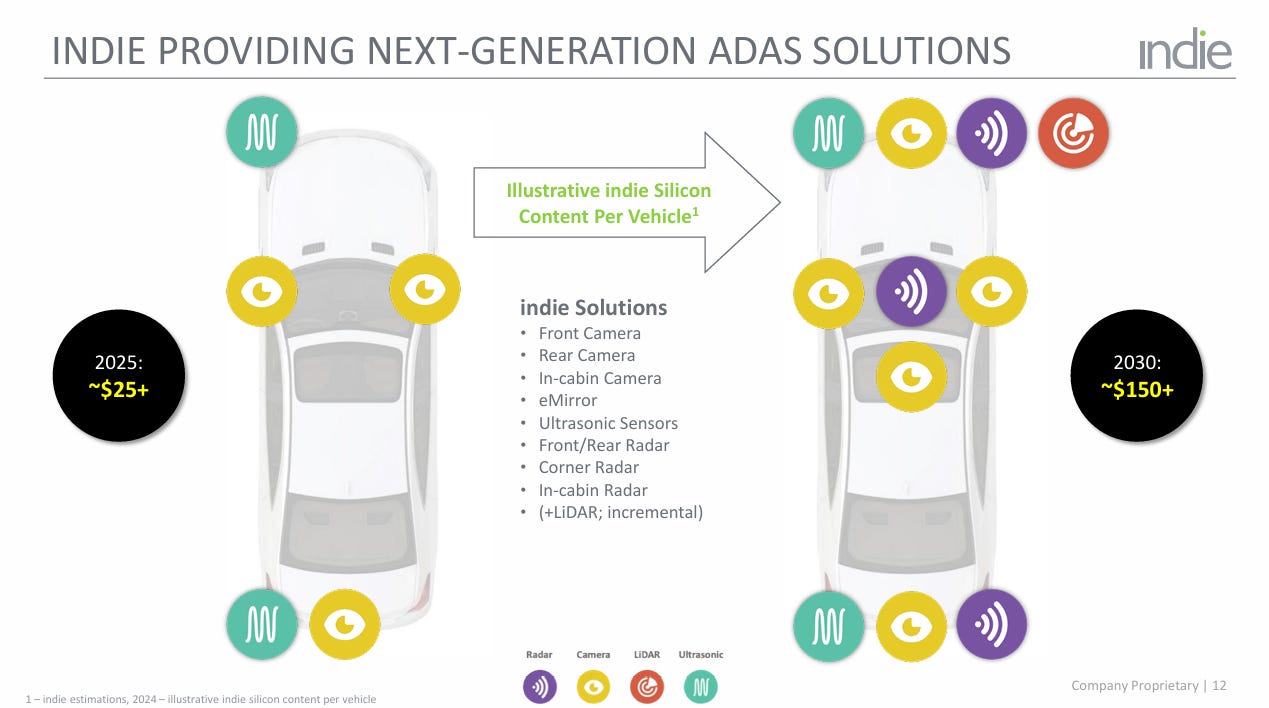
Proof this isn’t a slide deck fantasy: indie has shipped 550M+ SoCs cumulatively through 2025, up from 400M+ in 2024 and just 29M in 2016. Design win breadth keeps widening too. The Tier 1 radar partner’s $25M production order booked in Q1 2026, representing “the first 4TX 8RX radar available in the industry” per management, spans mainstream and commercial vehicles across Europe, Asia, and the U.S., and management confirmed more customers are layering in behind the initial two OEMs.
On the Q4 2025 call, management sized the underlying opportunity directly, describing annual demand as “well above 50 million units” once past the ramp-up phase.
That’s the base case. Now here’s the part of the story that actually changes the multiple.
Why the DRAM-less architecture matters more than anything else, specifically in auto
Every semiconductor company on earth is currently explaining DRAM cost inflation as a headwind on its earnings call. indie is one of the only companies that gets to present the shortage itself as a selling point.
The iND880 vision processor eliminates the external DRAM chip from the image signal processing pipeline entirely, a deeper change than a cost optimization on a spec sheet: a part that physically doesn’t need to exist on the board. No external memory means no memory allocation risk, no board space for it, no power budget for it, and no separate supplier relationship to manage for it.
Removing that chip matters far more today than it would have two years ago. TrendForce started 2026 forecasting DRAM contract prices up 50-55% quarter over quarter, then revised that to 90-95% QoQ for conventional DRAM by February, with PC DRAM alone projected to more than double in a single quarter. By Q2, LPDDR5X was up 89% QoQ and DDR4 up 51%. AMD told the industry not to expect DDR5 pricing to normalize until 2028. IDC estimates AI data centers will consume roughly 70% of global memory output in 2026, and every wafer that becomes an HBM stack for an Nvidia accelerator is a wafer that doesn’t become conventional DRAM. Global DRAM supply growth is running at just 16% year over year, and new fab capacity from Micron and SK Hynix doesn’t reach volume production for years.
Don McClymont’s own words on the Q1 2026 call capture it better than any outside data point. He called the DRAM-less design “a defining advantage of the iND880 and increasingly a focal point in our customer engagements,” and put the customer problem plainly:
“In many cases, our customers are unable to source memory at all.”'
Not expensive. Unavailable. When memory can be sourced at all, he added, it comes at a price premium measured in multiples, not percentages. The language across the last three earnings calls has escalated too, and that progression tells you this wasn’t a one-quarter talking point. On the Q4 2025 call, management framed the architecture as creating new opportunities tied to BOM savings, a competitive-differentiator pitch. By Q1 2026, it had become a focal point in customer engagements in management’s own words, expanding from Chinese OEMs specifically to U.S. customers on compressed timelines.
There’s a structural reason this holds up beyond just good timing. Automotive vision systems run on legacy DDR3 and LPDDR4-class parts, older nodes that Samsung, SK Hynix, and Micron are actively winding down as they redeploy fab capacity toward HBM and DDR5. So even if the headline AI memory supercycle eventually cools, automotive-grade commodity DRAM could stay scarce for a reason that has nothing to do with AI demand at all: the suppliers are exiting that category, and automotive qualification timelines run roughly seven years, so a supplier that exits doesn’t come back on any schedule that helps a car program next year. That advantage doesn’t mean-revert with spot pricing.
There’s also precedent for how far this kind of architecture can travel. Silicon Motion built its business on DRAM-less SSD controllers, a design that started as a niche, cost-down alternative and became the default architecture across client SSDs. Eliminating a dependency has a track record of going from stopgap to category standard once the reliability case proves out.
The buyer signing off on this design win matters as much as the design itself. It’s automotive procurement and that function lived through the 2021-22 chip shortage and the line-down events that came with it. “This part cannot strand your line on memory allocation” reads to that buyer as an insurance policy against a repeat of 2021-22, and insurance sells on a different urgency curve than a cost pitch ever does.
It’s already converting to real revenue too. The iND880 went from design win to volume production at NIO for eMirror functionality in roughly six months. A camera mirror system with the largest Chinese OEM is entering volume production. Beijing Auto Show design wins include the Buick GL8, AITO M9, NIO ES9, and Cadillac VISTIQ. Management has also disclosed design wins in eMirror and camera mirror systems across passenger vehicles and trucks with leading Tier 1s, production beginning in late 2026.
Management is already citing “tens of millions of dollars per year in annual revenue” for this single line, growing fast enough that it could exceed radar revenue in 2026, the same radar program that just booked a $25M order.
One more data point worth knowing: indie itself had to navigate a package substrate shortage in 2025, the same AI-driven demand spike squeezing its own manufacturing supply chain, before qualifying second-source substrate and packaging vendors. A company that has had to solve its own component scarcity problem in real time can credibly sell a scarcity-proofing architecture to its own customers, having lived inside the same dynamics it’s now monetizing downstream.
I am unsure if this iND880 vision processor will be used for humanoids or the iND881, but this DRAM-less architecture is a real commercial advantage for smart / autonomous vehicles and any prospective clients/applications adopting it.
iND881: the newest chip, and the one aimed straight at the Physical AI thesis
indie published a new product page for the iND881 series in June 2026.. The iND881 builds directly on the iND880’s ISP core, the same low-latency, multi-camera image processing engine already in eMirror and camera mirror production, and adds a genuine on-device AI compute engine on top of it: a 2 TOPS neural processing unit paired with a 500 GOPS DSP, tuned for real-time object detection and scene understanding rather than just image cleanup.
Two variants ship, iND88140 at the higher end (700 MP/s, 2 TOPS, quad-core application processor) and iND88120 at the lower end (350 MP/s, 1 TOPS, dual-core), a deliberate two-tier structure built to win a range of customer price points rather than one (Think the lower price and higher price Unitree models, for example).
The applications list is the part that matters most here. Alongside the expected automotive uses, ADAS, eMirror, DMS/OMS, parking and back-up cameras, indie’s own product page lists “smart cameras for AMRs and Humanoids” directly under Industrial and Consumer applications. This comes straight from the company’s own product marketing naming humanoid robotics as a target market for a specific, shipping part.
It’s also a more natural fit for what a humanoid actually needs than the ISP-only iND880. A robot navigating a warehouse or a living room has to make decisions from its video feed in real time, not just clean the image up, object detection and scene understanding, the exact workload indie built this chip’s NPU and DSP to handle. If that’s the direction indie’s humanoid content moves over time, and a product roadmap this specific suggests it is, iND881 rather than iND880 could end up carrying more dollars of content per unit, not less, even though it gives up the DRAM-less advantage to get there.
iND881 needs a 32-bit LPDDR4(x) external DRAM interface, confirmed in four separate places on its own spec sheet, so it doesn’t inherit the memory-scarcity moat built around the iND880. Whether that matters commercially depends on how the disclosed Unitree and Figure AI design-ins evolve from here, both are currently described as running on iND880-powered cameras, the ISP-only tier. If those relationships stay on iND880, the DRAM-less thesis holds as written above. If they migrate toward iND881-class compute as robot autonomy gets more sophisticated, which looks like the more likely direction over time, the content opportunity probably gets bigger, but the memory-scarcity argument stops applying to it specifically. Both things can be true at once, and management hasn’t yet disclosed which tier future design wins will run on.
Physical AI: four straight quarters of confirmation
In August 2025, on the Q2 call, McClymont disclosed indie’s first commercial success with iND880-powered cameras shipping into humanoid robots. In November 2025, on the Q3 call, he confirmed the relationship in the clearest terms indie has given, describing new content at “leading robotics providers, figure.ai and Unitree,” who use indie’s automotive products directly for their own applications. Humanoid robotics was added to indie’s $7.4B strategic backlog for the first time, and he called the interest an “unexpected positive.” By February 2026, indie’s ADAS technology was framed as the robot’s eyes and ears. By May 2026, the language shifted to sizing the opportunity, citing Yole Group’s forecast of the global humanoid market growing from $600M in 2025 to $6B by 2030 and then $51B by 2035.
Normally a stock would soar on confirmed content at just one of these two companies. indie has disclosed deals with both, confirmed by the CEO directly. On an earlier call, McClymont went further on why the fit works, saying indie’s automotive products are “basically 100% compatible with the needs that these guys have for these applications,” the same silicon, not a redesigned product line. Figure AI alone has stated plans to produce 100,000 humanoid robots over the next few years out of its dedicated BotQ manufacturing facility.
By Q1 2026, management described “tremendous growth in interest and activity in quantum and robotics” as a defining feature of the quarter.
One speculative data point worth flagging as exactly that, speculation, not a confirmed relationship: indie’s LinkedIn recap of its presence at the Optica Quantum 2.0 Conference, covering a presentation delivered by Philipp Vorreau, drew likes and comments from multiple Intel employees, including Run Levinger, whose title is Principal Engineer for quantum computing control at Intel Corporation, and Roee Ben-Yishay, an mmWave and RFIC designer at Intel, who commented directly on the quality of the papers presented. Engagement from name-matched employees at a specific company, especially one working on quantum computing control specifically, the exact discipline indie’s DFB laser platform sells into, is the kind of pattern worth noting rather than ignoring. It is not evidence of a partnership, a design win, or even a conversation, and should be read as nothing more than an incremental data point until something firmer is disclosed.
Why humanoid scale keeps compounding well past 2030
Everything modeled below through 2030 should be read as early-innings scale, not the final destination. The realistic debate in humanoid manufacturing isn’t whether the leading OEMs eventually reach multi-million and then double-digit-million annual unit volumes, it’s when. Unitree shipped 5,500 units in 2025 and guided to 20,000 for 2026, a 3.6x jump in one year. Figure AI’s BotQ facility is explicitly designed to keep adding production lines toward its own multi-hundred-thousand-unit ambitions. Tesla has publicly floated an eventual 10-million-unit annual capacity target at Gigafactory Texas. These companies are sizing their factories for the demand curve they expect in the early 2030s, not for where volumes sit today.
The binding constraint on how fast that curve bends isn’t primarily capital anymore, and it isn’t primarily the AI stack either, which has improved faster than almost anyone modeled eighteen months ago. It’s the upstream precision component supply chain: harmonic drives, NdFeB magnets, and dexterous-hand tactile sensors, categories where few qualified global suppliers currently exist. That’s a real bottleneck, closer to standing up new semiconductor fab capacity than adding a stamping line, and it’s the actual variable that determines whether the industry crosses into the multi-million range by 2030 or by 2032/2033.
There’s a real case that this bottleneck breaks faster than the McKinsey-style supply chain reports currently assume, because this exact pattern, “impossible” component scale-up on a compressed timeline, has already played out in adjacent Chinese industrial supply chains. Green Harmonic, now likely Tesla’s primary harmonic reducer supplier, was a small-cap gearing company in 2022. Ningbo Tuopu was an obscure auto suspension parts maker in 2016 and now likely builds actuators for Optimus. China’s own playbook in solar, batteries, and EVs has consistently been to flood capital into a component category ahead of confirmed demand and let capacity growth pull the market forward, exactly the BYD precedent underneath this whole argument: BYD went from roughly 200,000 NEVs to over 4 million in about five years once that playbook engaged. If that same state-backed, capital-flush approach gets pointed at harmonic drives and NdFeB magnets specifically, and there’s real reason to think it will given China’s explicit “hard tech” policy language around embodied intelligence, the five-supplier bottleneck could loosen considerably faster than conservative sell-side models currently assume.
That playbook comes with a catch worth remembering: it tends to arrive with brutal price destruction and consolidation along the way, the same thing that happened to solar module makers and is now happening to EV assemblers competing on price in China. That matters more for Unitree’s own hardware margins than it does for indie’s content-per-unit economics, since indie sits one layer up the stack selling sensing and processing silicon into whichever OEMs win the volume war, not competing for share of the robot itself. A supply-flood scenario that multiplies units while compressing OEM margins is, if anything, a better outcome for indie’s silicon content than a slower, higher-margin, lower-volume path would be.
That’s why the multiples in the valuation work below don’t collapse by 2030 the way a normal maturing business’ would. The market has to price in some of the 2031-2035 curve today, and increasingly over the next several years, precisely because by the time the hockey stick is obvious in the reported numbers, the re-rating will already be behind you.
Blending Unitree and Figure AI into one Physical AI shipment base
Unitree is the headline name because of the IPO timing, but indie’s disclosed exposure runs through both companies, and Figure AI’s own production plans are a meaningful second engine. Figure’s BotQ facility launched with an initial line capable of up to 12,000 units annually, building toward a stated goal of 100,000 cumulative robots over four years. Our base case uses a Figure AI ramp reaching 250,000 units by 2030, blended with a Unitree base case reaching 500,000 units by 2030.
That Unitree figure runs well above Morgan Stanley’s 446,000-unit forecast for the entire China market, not just Unitree, by 2030. We’re making that call deliberately rather than defaulting to the bank number. Sell-side humanoid estimates get revised every few months right now, and the pace of price collapse, capacity announcements, and design-win disclosures over just the past two quarters argues that the consensus curve is lagging reality rather than leading it. Treat this as a house view that we’re willing to be wrong on, not a hedge.
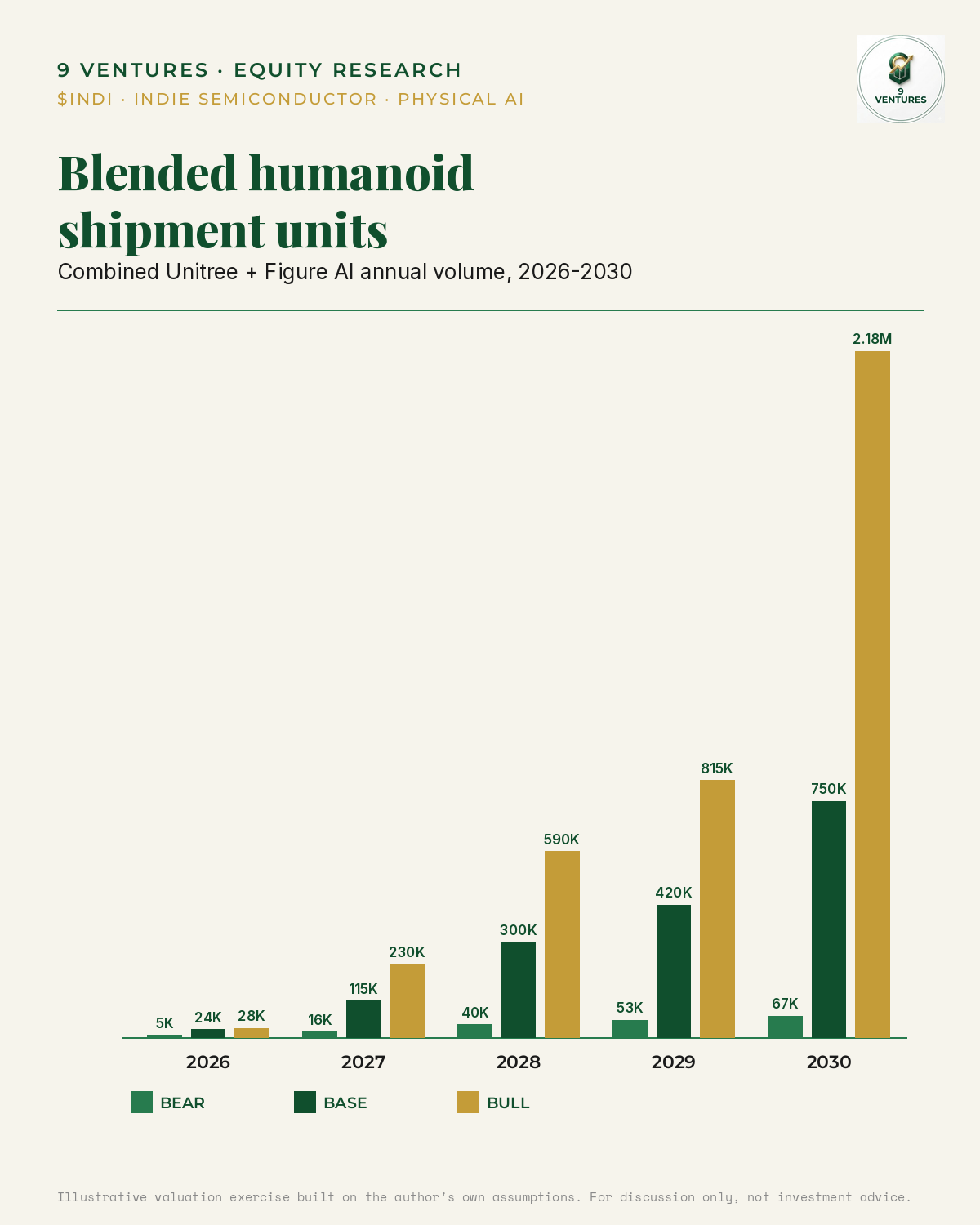
Content per unit is $150 across all three scenarios, bear included, so bear’s lower dollar contribution comes entirely from fewer units shipping. Bear assumes both companies undershoot current guidance. Base reflects my own above-consensus view of both companies’ trajectories rather than a straight read of disclosed plans. Bull compounds Unitree’s own demonstrated 2025-2026 growth rate forward and gives Figure AI a similarly steep, if less proven, ramp. Even the bull case’s 2.18M combined units by 2030 sits well below the industry-wide multi-million-per-OEM outcome discussed above, an early stage of that curve rather than its endpoint. I still sit in the camp that we see many million deployments of humanoids by OEMs, including Optimus.
There’s also an evidence trail worth naming. Automotive supplier pivots into humanoid actuators have another concrete precedent now beyond Green Harmonic and Ningbo Tuopu: Shuanglin Group, an existing gear and motor manufacturer retooling toward planetary roller screws for robotics. Over half of humanoid component categories already overlap with the EV and consumer electronics supply chains, which is exactly why Tesla, Mercedes-Benz, Changan, SAIC, XPeng, and GAC are all entering embodied intelligence through internal programs, joint ventures, or incubation, several of which are already indie automotive customers or prospects in their own right.
Worth addressing directly: does Unitree’s own aggressive price collapse threaten indie’s content-per-unit assumptions? The evidence says no, and the reason is informative. Unitree’s own production cost per unit fell far less over the same period, from 73,200 yuan (~$10,800) in 2023 to 62,200 yuan (~$9,175) by late 2025, only a 15% decline against a 72% drop in selling price. That gap says the ASP collapse is coming from Unitree compressing its own margin to chase volume and scale, sourcing over 90% of core components in-house, not from gutting the functional sensor and compute stack a robot needs to actually work. A camera, an ISP, and a perception chip are specialized components a humanoid cannot function without, closer to the electronics in a car than to a trim level that gets value-engineered down first when a product chases a lower price point.
GGII’s fresh numbers reinforce the scale case: China’s humanoid shipments hit 14,400 units in 2025 and are projected to reach 100,000 to 200,000 units in 2026 industry-wide, well above Unitree’s own 20,000-unit guide alone, meaning the broader China market indie’s OEM relationships sit inside is scaling faster than a single-company view suggests. It also means that Unitree is likely scaling faster than their stale guide.
What’s on a Unitree robot, and what indie’s share is worth
Unitree’s G1 sells for roughly $13,500-$16,000. The R1 entry model starts around $5,600-$5,900. Against that pricing backdrop, indie’s addressable content sits in vision (camera ISP via iND880), potentially LiDAR (iND83301 SoC), and perception software royalty (emotion3D). Content per unit is $150 across bear, base, and bull cases alike. The logic: a humanoid processing visual and auditory input at the low latency embodied AI requires isn’t meaningfully different in sensing and compute demands from what indie already charges for in an autonomous car, so there’s no reason the per-unit content should sit meaningfully below where the ADAS content curve is already headed, and no reason it should vary by scenario. What differs between bear, base, and bull is entirely shipment volume, not content per unit.
This is, transparently, an assumption that I am still working on. It does adjust the potential valuation model if it goes up or down.
The image sensor acquisition: completing the stack
The June 2026 investor deck disclosed indie’s agreement to acquire AMS OSRAM’s CMOS image sensor group: €40M total consideration, €35M cash at closing, expected close Q3 2026, immediately accretive per management. It completes indie’s full sensor stack and is explicitly described as a “Physical AI Beachhead,” sitting inside a market indie sizes at $4.21B by 2030 for CMOS image sensors specifically. Before this deal, indie built ISPs downstream of someone else’s camera sensor, the single most expensive and IP-rich component in a camera node, and never captured that dollar. Now it does, which is the direct mechanical enabler of the jump from indie’s current ~$25 content per vehicle toward the $150 endpoint, and the missing layer in the Physical AI pitch specifically.
Separately, the June deck disclosed a new software royalty line: per-vehicle licensing on DMS/OMS and forward vision perception software, the first meaningful software licensing stream in indie’s history. The Mahindra win is already in production, near-100% incremental margin once it scales.
The third leg: photonics and quantum
indie’s DFB laser platform now includes the world’s first commercially available ultraviolet DFB laser at 399nm, matched to the atomic cooling transition of ytterbium. The company shipped roughly $1M of optical products into quantum applications in 2025, expecting that to roughly triple in 2026. Small in dollars today, a pure call option on a market growing independent of anything happening in Detroit or Shenzhen.
The financial model
Everything below is an illustrative modeling exercise built on stated assumptions, not company guidance.
Wuxi is a Chinese subsidiary indie controls but only holds a 34.38% equity stake in, a lighting and motor-control chip business, structurally separate from the vision, radar, and ADAS silicon this report is actually about. Because indie controls it, US GAAP requires full consolidation, 100% of Wuxi's revenue shows up in indie's reported top line today, not a 34.38% pull-through. indie agreed in October 2025 to sell its entire stake for roughly $135M in cash, and Wuxi fully deconsolidates once the deal closes, expected sometime in 2026. Wuxi has run flat to slightly down for two years, it's roughly 40% of current revenue and has been consistently so, not a growth contributor, and management has said directly that it's meaningfully lower-margin than the core business, so its exit should improve blended gross margin, not hurt it. Since Wuxi fully deconsolidates on close rather than fading out gradually, the honest way to model it is a clean cutover: Wuxi contributes through 2026, then drops out entirely, with core Automotive growth picking up the pace management itself has described as accelerating, roughly 20% year-over-year most recently, before layering in the radar, eMirror, image sensor, and software royalty ramps this report already covers in detail.
The 60% bull-case gross margin ceiling comes straight from management’s own long-term target, not something invented for this model.
Asked directly on the Q3 2025 call what margin and breakeven look like excluding Wuxi, Don McClymont didn’t hedge, reaffirming the company remains “committed to getting to the 60% gross margin level of the target model” it set for itself.
Base case 2030 deliberately stops three points short of that, at 57%, on the view that base reflects a slightly slower mix shift than bull’s more optimistic content and volume ramp. Both are real, disclosed ceilings management has pointed to, not invented multiples.
Segment-level figures shown in the SOTP below are that same consolidated margin applied to each segment’s own revenue, not a separately assumed margin per segment. Segment revenue splits into three lines: Automotive (core ADAS/UX, Wuxi through divestiture, software royalty), Physical AI (blended Unitree and Figure AI content plus, in bear and base, a supporting Other Physical AI line), and Photonics/Quantum.
Automotive carries the overwhelming majority of revenue throughout. In the base case it grows from $264.4M in 2026 to $696.0M by 2030, with Physical AI scaling from a rounding error to $214.5M and Photonics from $3.0M to $28.0M over the same span. The bull case pushes Automotive to $1,300.0M and Physical AI to $327.0M by 2030, while the bear case holds Automotive to $495.5M and Physical AI to $101.5M. Total revenue, gross margin, and the resulting EBITDA across all three scenarios sit below.
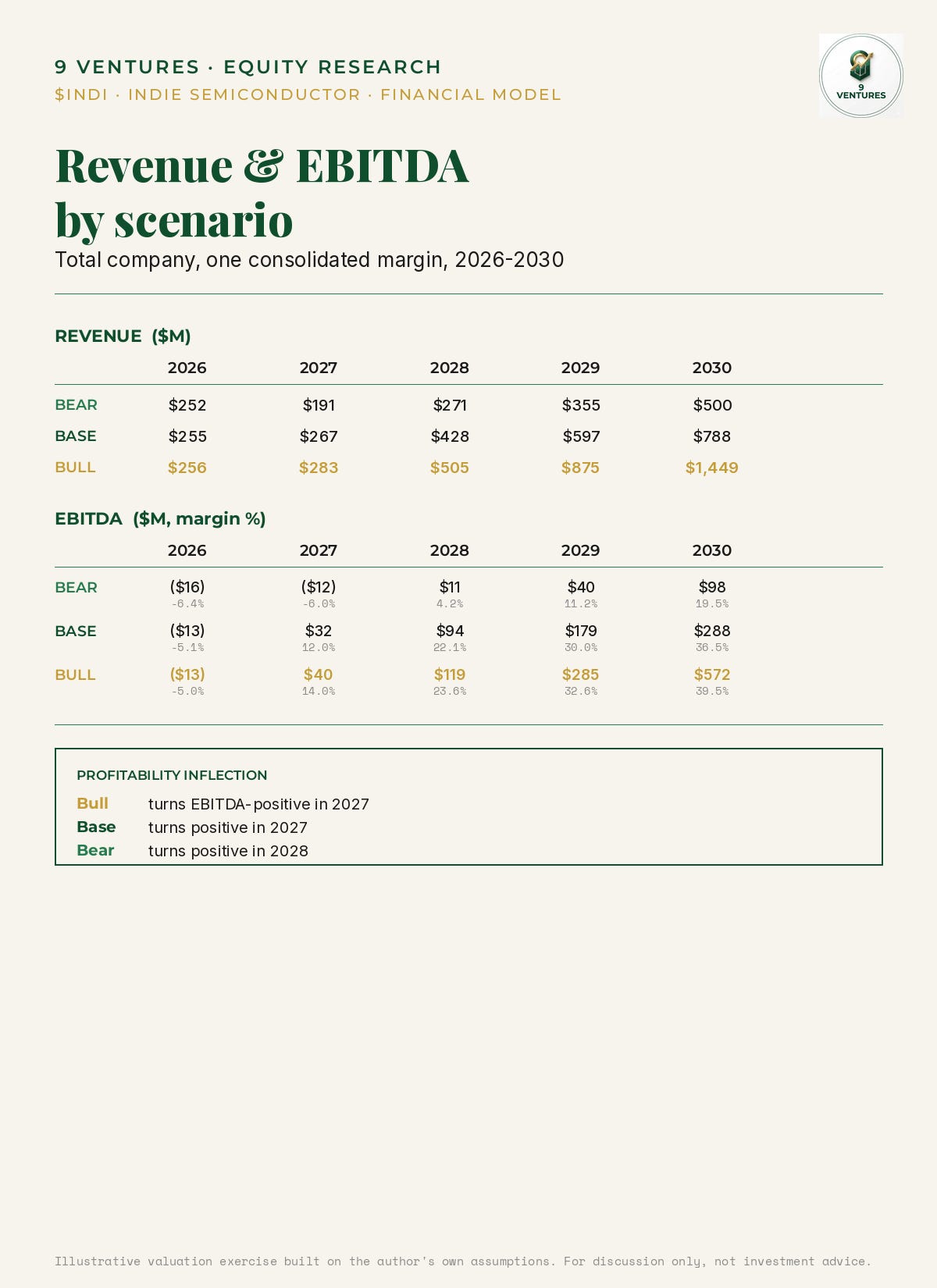
The 2026-to-2027 step is a one-time optics effect, not a sign of weakness, roughly $94M of flat, lower-margin Wuxi revenue exits entirely while the core business keeps growing underneath it. Base and bull show only a modest net dip, -9.0% and -3.1% respectively, since accelerating core growth offsets most of the loss. Bear shows a sharper -28.3% step, since its slower core growth can't offset the exit as well, arguably appropriate for a bear case, but worth naming plainly rather than leaving an unexplained decline sitting in a headline number.
Non-GAAP EPS: bear stays negative through 2027, building from ($0.22) in 2026 to ($0.19) in 2027, crossing into thin positive territory at $0.02 in 2029 and reaching $0.21 by 2030. Base turns profitable already in 2027, essentially breakeven at $0.01, building to $0.81 by 2030. Bull turns profitable in 2027 too, at $0.04, the strongest of the three, reaching $1.72 by 2030.
2026 is a shared, roughly breakeven-adjacent year across all three scenarios, base and bull both inflect in 2027, helped by gross margin doing most of the early work, and bear stays a slower, later story. Every one of these figures sits on a revenue base that conservatively excludes a stagnant, lower-margin, soon-to-be-divested Chinese subsidiary.
One more piece worth calling out explicitly: the Wuxi cash proceeds are a real balance sheet event, separate from the revenue story. The sale brings in roughly $135M gross, or about $108M net of an assumed 20% tax, arriving roughly in step with the divestiture closing. That cash strengthens the balance sheet precisely as indie is scaling into radar, eMirror, and image sensor production ramps that need working capital, taking pro forma net debt down to roughly $122M, and is explicitly reflected in the net debt figures used throughout the SOTP below. Losing Wuxi’s revenue and gaining Wuxi’s cash are two different, both real, effects, worth keeping separate rather than letting the first obscure the second.
I might be understating the auto revenue growth in 2027 & 2028, but want to be pragmatic with the Wuxi divestiture. Something I can continue to iterate upon. I might be understating the photonics / quantum growth, too. I just haven’t spent enough time here, as it is likely the most far out of the three segments.
I AM CONSERVATIVELY SITTING BELOW CONSENSUS SALES FOR 2027 & 2028 AND WE STILL GET ~200% UPSIDE IN THE BASE CASE.
Sum-of-the-parts valuation
A single blended multiple understates what’s inside this company, since it would cap a hypergrowth robotics and quantum business at the same multiple as a maturing auto supplier.
Bear stays on EV/Sales for all four years, since consolidated margin only reaches 19.5% by 2030 and the segment-level EBITDA base is still thin. Base and bull both keep the same sales-basis multiples used in 2027 and 2028, since the underlying revenue in those years hasn’t changed, before shifting to EV/EBITDA from 2029 onward once real, disclosed-scale profitability is established.
Segment multiples, all three scenarios:
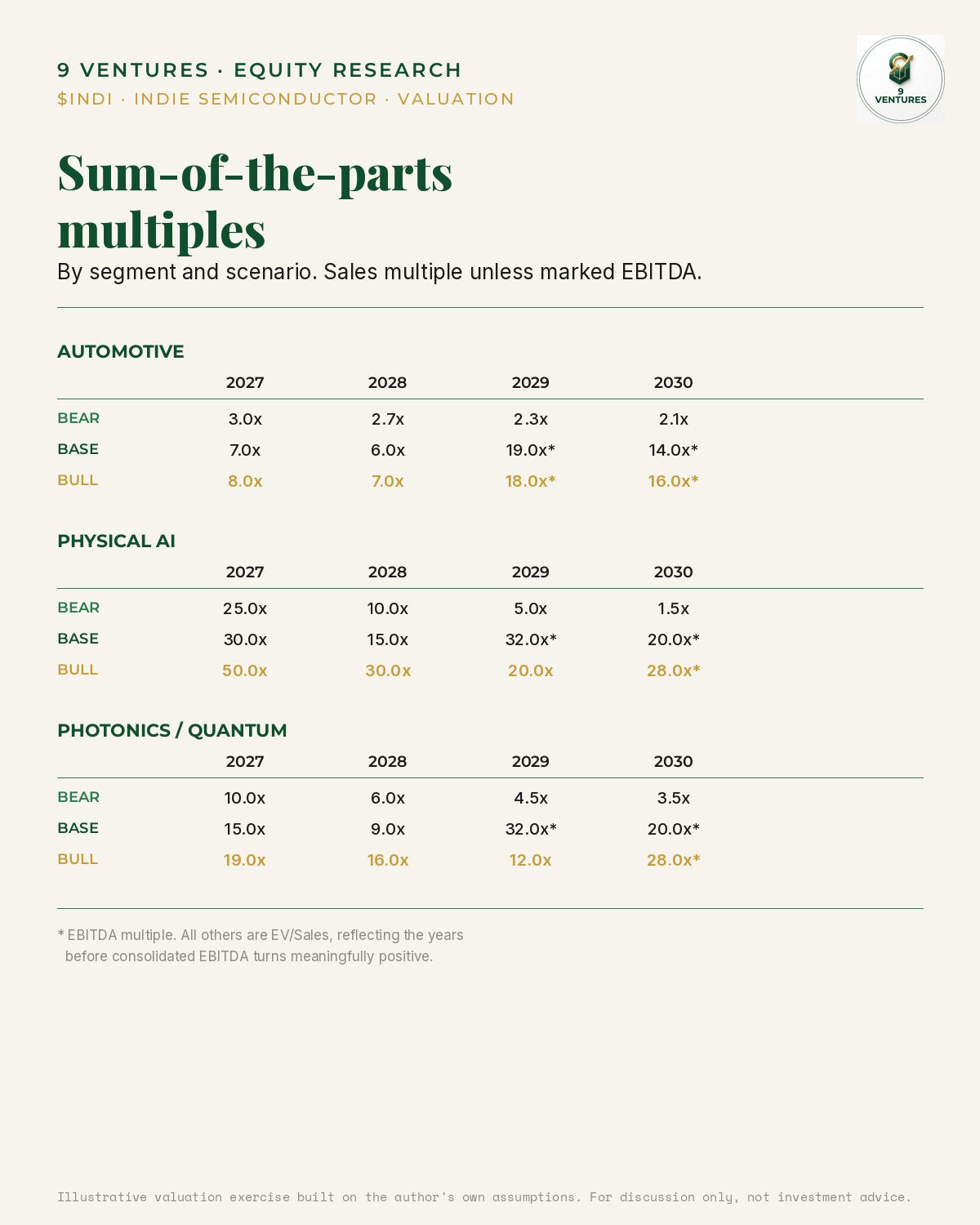
The base case’s Automotive multiple stepping down from 19x (2029) to 14x (2030) rather than climbing further reflects the segment’s own EBITDA scaling quickly enough that a stable, more moderate multiple already produces a rising enterprise value, the same logic as before, a business late in its growth curve doesn’t need an ever-richer multiple once the earnings base itself is compounding.
The multiples compress hard across the sales-basis years in every scenario, which is exactly the pattern you’d expect: richest when the segment is most dependent on the story, more modest as revenue scale grows and real EBITDA becomes the better yardstick.
Implied share price, all three scenarios:
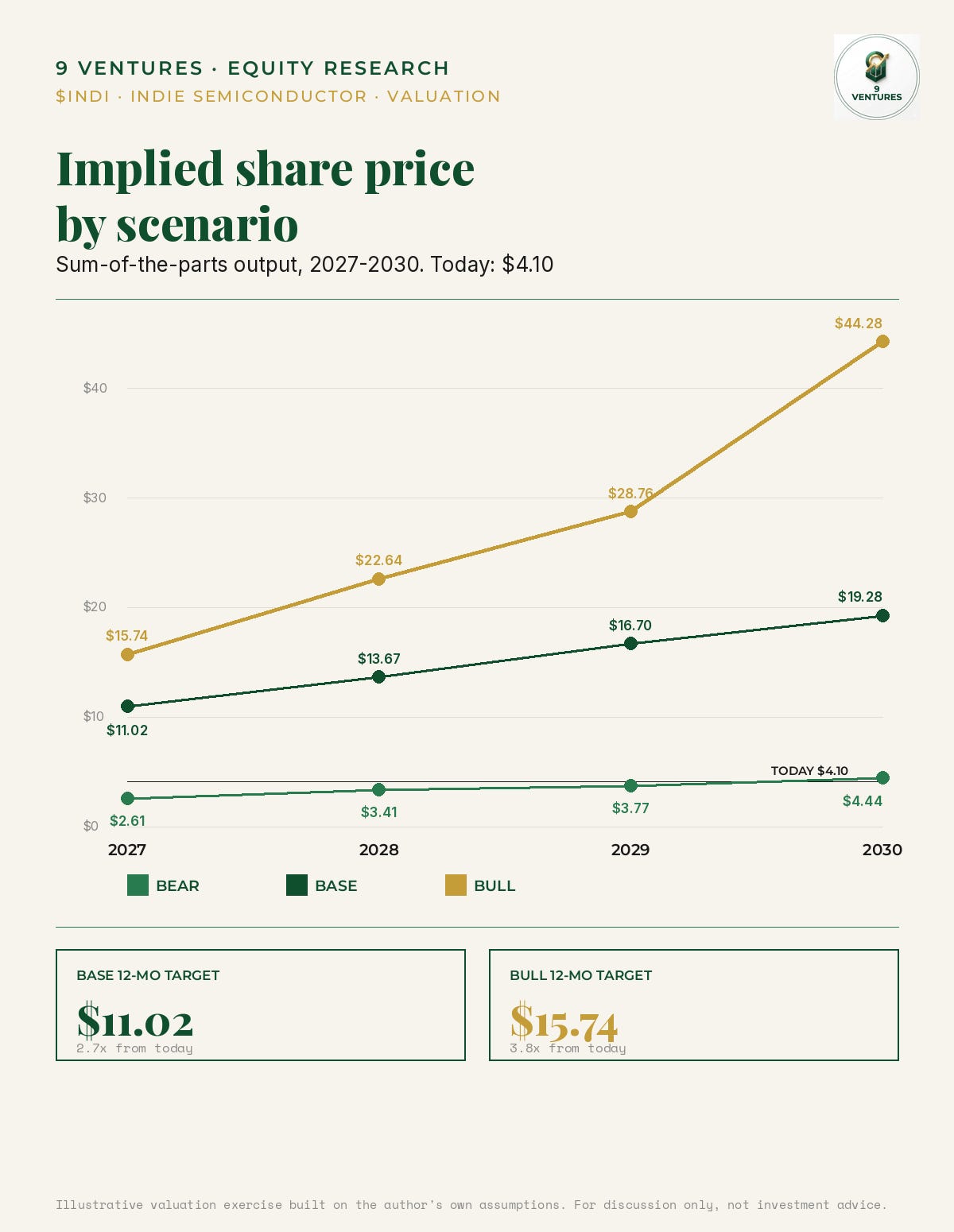
The bear case is a grinding, unexciting climb rather than a collapse, a gradual move from $2.61 to $4.44 as revenue keeps growing even though the business never really turns the corner on profit within this window. Auto’s own value stays modest throughout, a direct consequence of the Wuxi-excluded revenue base combined with bear’s weaker core growth assumption, the two effects compounding on top of each other in the scenario least equipped to absorb them. The full segment-level build behind it: Auto enterprise value climbs from $535M to $779M, Physical AI from $118M to $152M, Photonics from $80M to $98M, net of a balance sheet that swings from $122M net debt to a net cash position over the window.
The base case runs from $11.02 to $19.28 across the four years, with Auto EV growing from $1,583M to $2,789M and Physical AI from $999M to $1,566M. The bull case is where the divergence gets dramatic, $15.74 to $44.28, with Auto alone reaching $6,912M of enterprise value by 2030 and Physical AI $3,617M.
Auto stays the largest single segment in the bull case throughout this window, with Physical AI a substantial but consistently smaller second, one that carries relatively more weight in this corrected build than a simple eyeball of the segment sizes might suggest, since Auto’s own base is now properly scaled to exclude Wuxi. Treat the bull case for what it is, the scenario where the content ramp, the shipment compounding, and a sustained premium multiple all show up together across every segment at once. It’s a live possibility given how fast this market is moving, not a base rate, and the bear case is the reminder of what a stalled version of this story implies instead.
12-month price target
Pulling this together into a single number rather than a four-year table: our base case 12-month target is $11.02, and our bull case 12-month target is $15.74. Both are the 2027 output of the SOTP build above, not a separate estimate, so the reasoning behind them is everything already walked through: Auto's own content and design-win trajectory on a revenue base that properly excludes Wuxi, and Physical AI carrying a genuine premium multiple that reflects the hyper-growth expected across humanoid robotics through the 2030s rather than a discount for being early. The base case implies roughly 2.7x from today's $4.10, the bull case roughly 3.8x, over the next year. Both depend on the Unitree IPO actually landing in the next few weeks and the market starting to ask who else sits in that supply chain, the base and bull cases differ mainly in how much of Auto's own near-term content ramp converts on schedule.
Why the IPO is the trigger
Every thread above has been sitting in plain sight in indie’s own transcripts and decks for months without moving the stock. IPOs change that, they put a name and a valuation in front of generalist money that has never had to think about who supplies the sensors inside a humanoid robot. Once Unitree prices, likely within weeks, the natural next question from anyone allocating into that theme is who else is exposed to this. Right now, with a confirmed multi-quarter design-in and next to no market attention on the position, the answer is $INDI.
Risks worth sitting with
Four things could break this thesis independent of anything modeled above.
Slower humanoid adoption or development. If Unitree, Figure AI, or the broader humanoid ecosystem takes materially longer to reach scale than even the bear case assumes, Physical AI could stay a rounding error on indie’s income statement well past 2030, not just through the near-term years modeled here.
ADAS market slowdown. Auto still carries most of enterprise value in every scenario in this report. A broader auto production downturn, a pause in ADAS regulatory mandates, or an OEM capex pullback hits the segment everything else here is built on top of.
A valuation discount for China exposure. indie’s revenue runs through Chinese OEMs (NIO, AITO, the largest Chinese OEM’s camera mirror win) and the pending Wuxi divestiture. The market has shown a willingness to apply a blanket discount to US-listed companies with meaningful China revenue exposure on tariff, export control, and geopolitical grounds, independent of how the underlying business actually performs.
ADR-adjacent risk. indie trades as ordinary Nasdaq common stock, not an ADR, but its Wuxi equity stake and China-linked revenue invite some of the same scrutiny US-listed Chinese ADRs face, PCAOB audit access questions, VIE-style structural concerns, and headline risk from US-China regulatory or delisting actions, any of which could compress the multiple the market assigns even if operations are unaffected.
What has to go right, and what could go wrong
The bull case shipment path sits above institutional consensus, treat it as the bull case it is. indie hasn’t disclosed a per-unit content figure for Unitree or Figure AI, so all the BOM math here is a bottoms-up estimate. The SOTP multiples are stated assumptions built for illustration, swap in your own view freely. The real industry-wide bottleneck on reaching multi-million unit scale sits in the precision component supply chain, harmonic drives and magnets specifically, more than in capital availability, where fewer than five qualified global suppliers currently exist and a multi-year buildout stands ahead even with unlimited capital behind it. DRAM pricing could normalize faster than AMD’s 2028 timeline if hyperscaler capex cools. Wuxi still needs to clear Chinese regulatory approval before that ~$135M shows up. The core radar and vision ramps still need to execute cleanly, since none of the adjacent-market optionality matters if the base business stumbles.
None of that changes the shape of the trade. indie built a chip to solve its own bill-of-materials problem in cars. The memory market handed it a much bigger problem to solve, for free, in robots, and the company is still priced at ~4x sales and 2x 2028 consensus sales. Unitree’s IPO is about to test how long that lasts.
Not investment advice. Do your own diligence.
I really couldn't make any sense reading your setup remarks on your publication page, so I guess that really disqualifies me? I'm trying to give away multi-billion dollar easy to set up businesses on the theory but that it's easier to find an ambitious person than a rich person who can recognize good ideas?