$FCEL: A Data Center Turnaround Story

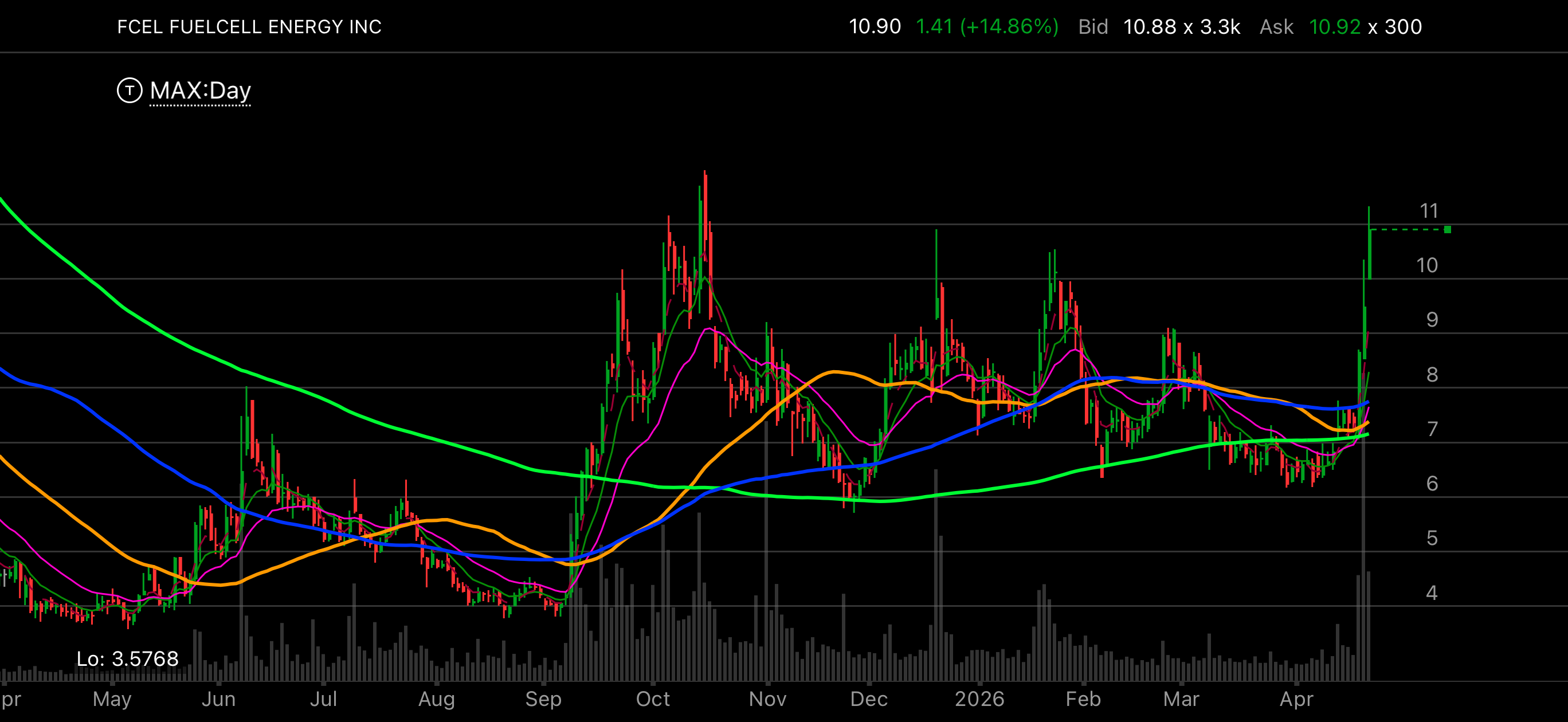
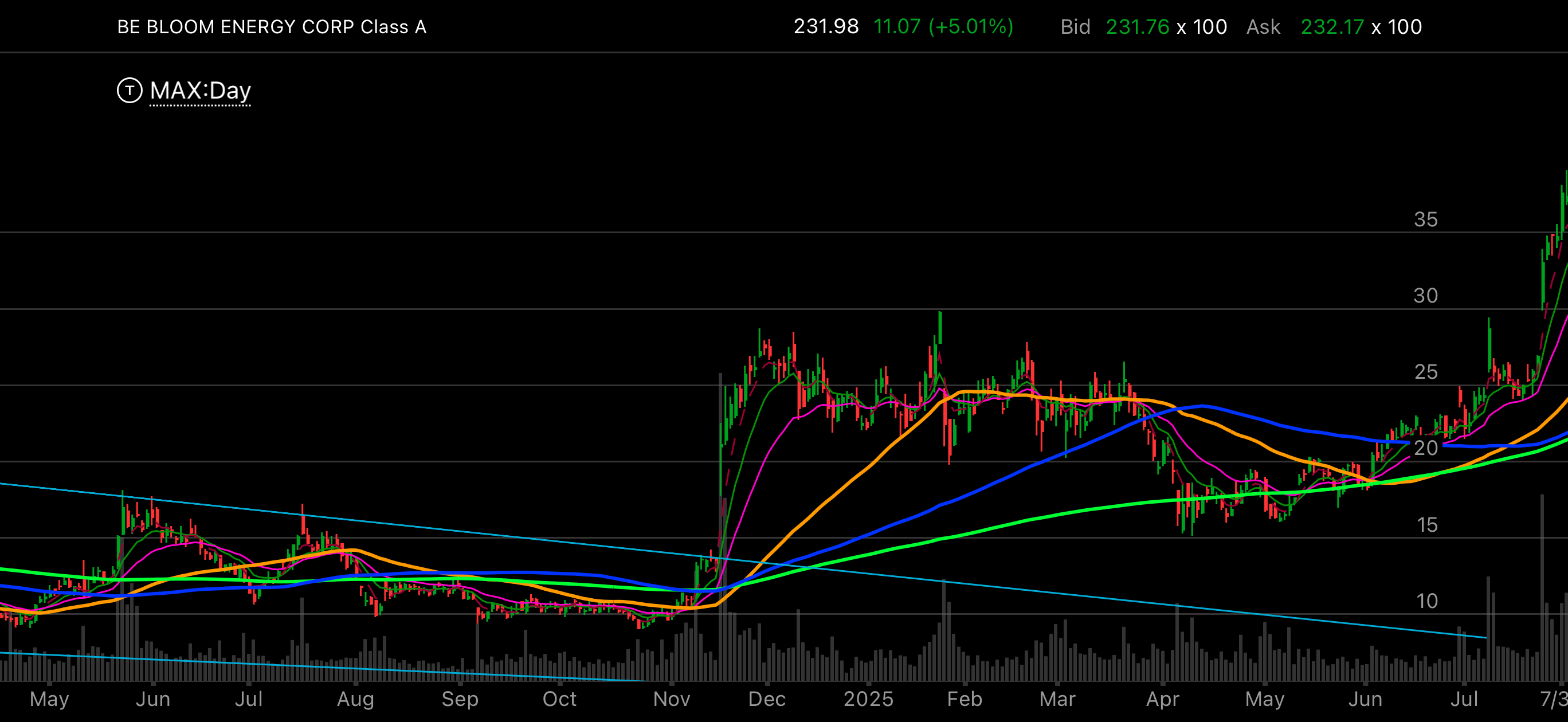
On April 21, 2026, FuelCell Energy traded its highest relative volume on record. The price action reflects a technical setup strikingly similar to the Bloom Energy chart in early 2025. During that period, $BE initiated a run from 20 to over 200. $FCEL currently displays even stronger accumulation patterns with 50%+ of the float trading over a two-day span. Short interest remains low at 7%, suggesting this movement is driven by fundamental accumulation rather than a short squeeze.
The Investment Thesis
The demand for AI infrastructure is outpacing the utility grid. Hyperscalers currently face five-to-seven-year delays for grid interconnections. FuelCell Energy offers a modular, onsite solution to bypass these queues. Over 80% of the current 1.5 GW sales pipeline focuses on digital infrastructure and data center projects.
Technical Differentiation and Efficiency
The push for AI-native infrastructure has shifted the focus from raw electrical efficiency to total system optimization. While competitors like Bloom Energy report higher raw electrical efficiency at 65% versus approximately 50% for $FCEL, the total energy output argument narrows this gap.
DC-Native Architecture: Both FuelCell Energy and Bloom Energy utilize fuel cells that produce direct current (DC) natively. $FCEL markets an 800-V DC architecture designed for direct-to-rack power. This eliminates the energy losses associated with multiple AC-to-DC conversion steps required in traditional grid-tied systems.
Thermal Integration: The $FCEL carbonate electrochemical process produces high-grade steam at temperatures near 700°F. This byproduct is directly compatible with absorption chillers. These chillers convert thermal energy into cooling for server environments. While $BE can capture high-temperature exhaust for cooling, the $FCEL carbonate chemistry provides this turnkey steam output inherently.
In a 100 MW deployment, this combined efficiency supports 77.2 MW of actual server load. A standard grid-connected configuration typically supports only 69.5 MW due to cooling and conversion overhead. This 7.7 MW advantage represents an 11% increase in usable IT power.
Commercial Momentum and Valuation
FuelCell Energy has transitioned from bespoke research projects to a standardized product strategy. The company now utilizes 12.5 MW power blocks for scalable data center deployments.
Sales Pipeline: The commercial pipeline for data centers has reached 1.5 GW. This represents a 275% increase in business development activity.
Manufacturing Scale: Management plans to triple production capacity at the Torrington, Connecticut facility from 100 MW to 350 MW.
Revenue Potential: $FCEL generates approximately $2.4M in revenue per MW. Reaching 100 MW in annual deployments implies $240M in revenue. Scaling to 350 MW creates an $840M annual revenue opportunity.
Market Multiples: FuelCell Energy maintains a market capitalization of ~$500M. This compares to a $66B MC for Bloom Energy. This isn’t to say FuelCell should be anywhere near Bloom, but it is good to see what the leader in the exact same industry can become. Tons of upside potential if FuelCell Energy were to become a firm number 2.
$FCEL currently trades at a significant discount to its peer on a sales multiple basis. The company maintains a strong balance sheet with approximately $380M in cash. Success depends on converting the 1.5 GW pipeline into a firm backlog. A single large-scale data center contract could serve as the catalyst to re-rate the stock closer to multiples seen by $BE. Lots of projection has to be done here, but this could be an early turnaround story as data centers are hungry for deployable power.