

$FCEL: Linking Fit Energy to 5C Data Centers / Hypertec
The counterparty picture just got a lot cleaner.

When we broke down the FCEL CEPA, the central question was: who exactly is Fit Energy, and can they actually identify 380 MW of U.S. data center sites?
The report below walks through that.
Two data points change how we frame this entirely.
1. Fit Energy was incorporated in October 2025, six months after a major merger inside Fit Ventures, and eight months before the CEPA was signed. It was purpose-built to be the energy counterparty in this deal.
2. Hypertec, the infrastructure operator inside Fit Ventures, is NVIDIA’s Canadian Partner of the Year and Intel’s Strategic OEM Partner of the Year in Canada. NVIDIA and Intel don’t hand those awards to fringe operators. One of North America’s most decorated AI infrastructure companies, 40 years in business, sits inside the same family office that just signed a fuel cell supply agreement with FCEL.
The Fit Ventures Empire
The Fit Ventures portfolio page, confirmed directly from fitventures.com, lists the following holdings:
5C Data Centers, next-gen AI data center campuses across the U.S.
Hypertec, HPC & AI infrastructure, founded 1984, NVIDIA and Intel Partner of the Year
UVEYE, AI-powered vehicle inspection (Series C-stage)
BusPatrol, AI safety technology for school buses
Shielda, cybersecurity
Thrio, AI-powered contact center software
DBFF, David Baazov Family Foundation
And now: Fit Energy, the entity that signed the FCEL CEPA.
The ownership chain is straightforward: David Baazov → Fit Ventures → Fit Energy, 5C Data Centers, and Hypertec, all under the same roof.
Hypertec Cloud acquired 5C Data Centers in April 2025, forming 5C Group, a combined entity that unites Hypertec’s cloud computing capabilities with 5C’s data center footprint. Baazov’s family office seeded both sides of that merger. Fit Energy was incorporated six months later. The CEPA followed eight months after that.
Fit Ventures runs a vertically integrated AI infrastructure operation. They build the data centers (5C), supply the servers and compute clusters (Hypertec), and with Fit Energy now in place, they have the dedicated arm to provision baseload power for all of it.
The FCEL CEPA is the final piece of a supply chain Fit Ventures has been quietly assembling.
Hypertec: 40 Years, Award-Winning, Blackwell Already Deployed
Founded in 1984. Headquartered in Montreal. Serves clients in over 80 countries. A partner network of 800+ technology providers globally.
Awards:
NVIDIA Canadian Partner of the Year, 2025 (announced at GTC 2025, March 19, 2025). Recognized for advancing HPC and generative AI across Canada using the full-stack NVIDIA platform across financial services, higher education, and research.
Intel Strategic OEM Partner of the Year in Canada, 2024 (and 2022, and 2020). Recognized at Intel Vision in Phoenix for pioneering sustainable immersion computing via Hypertec’s TRIDENT platform.
Best Innovative Manufacturer for Large Enterprise, 2023
EcoVadis Best Performer in the Americas, 2023
NVIDIA’s own blog called Hypertec out by name at GTC 2025, the most important AI infrastructure conference in the world. Peer validation, direct from the most important chip company on the planet.
The Blackwell connection is where it gets interesting. At GTC 2025, Hypertec Cloud deployed its first NVIDIA Blackwell HGX B200-accelerated cluster with Together AI, the same Together AI co-building the Memphis MEM01 Frontier AI Factory with 5C Data Centers. Both companies also announced plans to co-build an NVIDIA GB200 NVL72 cluster together.
Read that once more: Hypertec (Fit Ventures portco) builds NVIDIA Blackwell clusters for Together AI. Together AI deploys those clusters at MEM01, built by 5C Data Centers (Fit Ventures portco). Fit Energy (Fit Ventures energy arm) procures fuel cell baseload power from FCEL to supply those same facilities.
Closed loop.
Hypertec’s Five Divisions and Why Each One Matters
Hypertec runs five divisions that map almost perfectly onto the FCEL deployment thesis:
HPC & AI: CIARA-branded servers across AI & GPU, immersion-born, high-frequency, and high-density form factors. The compute infrastructure that goes into 5C’s AI factories.
Solutions Partner: IT products, cloud solutions, and integration. The services layer on top of the hardware.
Construction: High-density data center design and build, backed by 15+ years of HPC data center expertise. The division that physically builds the campuses where FCEL fuel cells would sit.
Custom Manufacturing: 30+ years of precision manufacturing. Hypertec builds its own servers via the CIARA brand, immersion-cooled and GB200-ready, designed for the AI factory use case.
Health: Telehealth and healthcare IT. Separate from the FCEL thesis.
The Construction division is the one to focus on. Hypertec has the in-house capability to design, build, and deploy the physical data center infrastructure at 5C’s expansion sites. Fit Ventures has no need to hire an external EPC contractor. The builder is already in the family.
One of Hypertec’s recent blog posts: “Planning a Data Center in the Next 4 to 12 Months? Prefab First. Power First. Or Expect Delays.”
Power First. That’s the product FCEL sells.
The October 2025 Incorporation: Fit Energy Was Built for This
The 5C/Hypertec merger closed April 2025. That transaction created a combined entity with a 2 GW U.S. data center roadmap, $835M in Brookfield and Deutsche Bank capital, and a team capable of designing, building, supplying, and operating AI factories at hyperscale.
Fit Energy was incorporated October 2025, six months after that merger.
The sequence: merge the data center and compute infrastructure businesses, create the dedicated energy procurement entity, sign the fuel cell power agreement. Fit Energy didn’t exist before this trade. A functional SPV inside an ecosystem with $835M in institutional capital, a 2 GW site pipeline, 40 years of HPC manufacturing history, and awards from NVIDIA and Intel.
The “fresh company” counterparty risk flagged in our original report looks very different with this context.
What 5C Data Centers Actually Is
5C describes itself as the full AI digital infrastructure provider, combining Hypertec’s cloud computing capabilities with a purpose-built data center footprint across the U.S.
The client roster is serious. 5C counts Together AI, Zyphra, NVIDIA, Intel, AMD, VAST Data, WEKA, DDN, and SambaNova as partners. Together AI’s CEO described the partnership as enabling “projects of vast scale with a high level of confidence in their speed, reliability, and success.”
The capital behind 5C is institutional. In July 2025, 5C secured $835 million, equity financing led by Brookfield Asset Management and debt financing led by Deutsche Bank, to accelerate development of its data centers and AI infrastructure across North America.
Brookfield. Deutsche Bank. $835M.
5C’s U.S. data center roadmap is 2 GW. The FCEL CEPA covers up to 380 MW, roughly 19% of that roadmap from a single supply agreement.
Note, that Brookfield also has a partnership with T5, who has signaled to be using FuelCell Energy’s fuel cells in their Fairfax County data center. Brookfield has a multi-GW partnership with Bloom Energy also.
The Five Sites: Where 380 MW Actually Goes
5C’s U.S. site table, scraped directly from 5c.ai, maps a current footprint of 515+ MW across five locations, all with 2027 next-phase delivery timelines. Four of five sites are fully committed today. Expansion capacity across the portfolio totals 1,535+ MW.
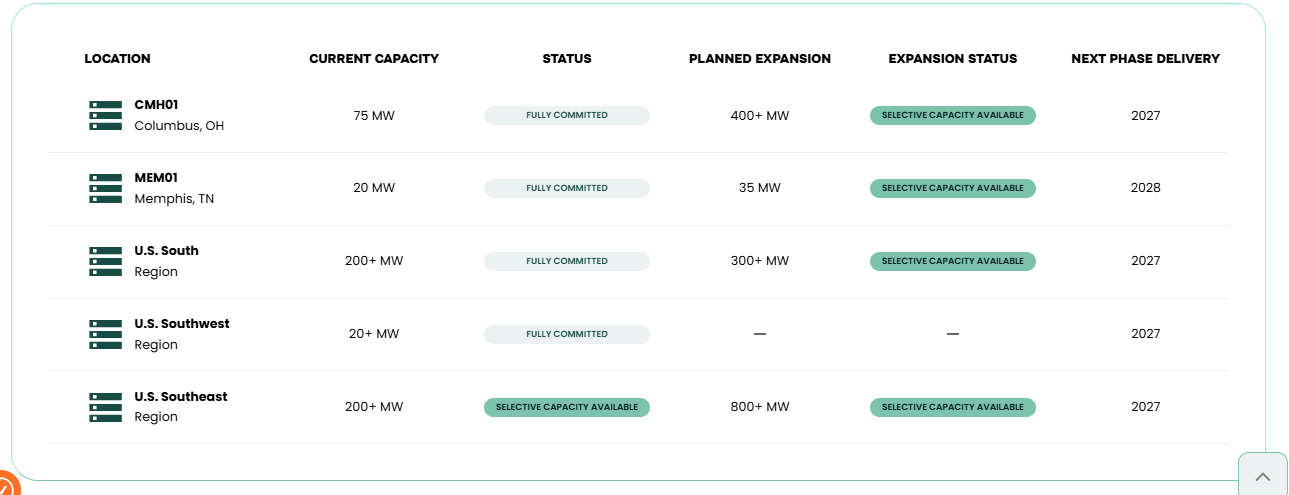
CMH01, Columbus, OH
Current: 75 MW | Status: Fully Committed | Expansion: 400+ MW | Next delivery: 2027
The flagship site. 5C’s most recent deal was a Corporate Asset Purchase covering 320,000 square feet in Columbus. Already full. The 400+ MW expansion is where fuel cell baseload becomes highly relevant. Grid interconnection timelines in Ohio are long, and combustion-free on-site generation that bypasses the queue is exactly the product FCEL’s 12.5 MW Energy Blocks are designed to deliver.
MEM01, Memphis, TN
Current: 20 MW | Status: Fully Committed | Expansion: 35 MW | Next delivery: 2028
Watch this one. 5C is building a Frontier AI Factory in Memphis jointly with Together AI, featuring NVIDIA GB200 NVL72 systems. The MEM01 expansion target is 35 MW. FCEL’s Phase 0 is 30 MW. The near-perfect sizing is deliberate. MEM01 is the most obvious Phase 0 deployment target in the portfolio. If Phase 0 delivers clean baseload power to Memphis while the Together AI factory ramps GB200 clusters, this becomes the reference site for the entire 380 MW buildout.
U.S. South Region
Current: 200+ MW | Status: Fully Committed | Expansion: 300+ MW | Next delivery: 2027
Full on current capacity. The 300+ MW expansion is a direct candidate for Phase 1’s 100 MW allocation. At 300+ MW of planned build, exactly the scale where FCEL’s modular block architecture (2.5 MW per block, up to 12.5 MW Energy Block clusters) works best.
U.S. Southwest Region
Current: 20+ MW | Status: Fully Committed | Expansion: None listed | Next delivery: 2027
Smaller footprint, no expansion listed. Phoenix was previously disclosed as a 5C location. Lower priority for FCEL deployment given the lack of expansion runway.
U.S. Southeast Region
Current: 200+ MW | Status: Selective Capacity Available | Expansion: 800+ MW | Next delivery: 2027
The biggest number on the board. 800+ MW of planned expansion at a site where 5C still has selective capacity available. The endgame location for Phases 2 and 3 of the FCEL CEPA, representing a combined 250 MW if both phases elect. The “Selective Capacity Available” status means 5C is still actively signing customers here, which tends to precede the large capacity commitments that would justify a Phase 2 or Phase 3 deposit.
The Full Stack
The Fit Ventures infrastructure build-out as it exists today:
Build the data center, Hypertec Construction
Deploy the servers, Hypertec HPC & AI (CIARA servers, GB200 clusters)
Operate the facility, 5C Data Centers
Power the facility, Fit Energy / FCEL
Every piece of that stack is linked to one family office. The FCEL CEPA is a potential power utility layer of an already-operating AI factory platform with real sites, real customers, real institutional backing, and real hardware partnerships.
Updated Counterparty Risk Assessment
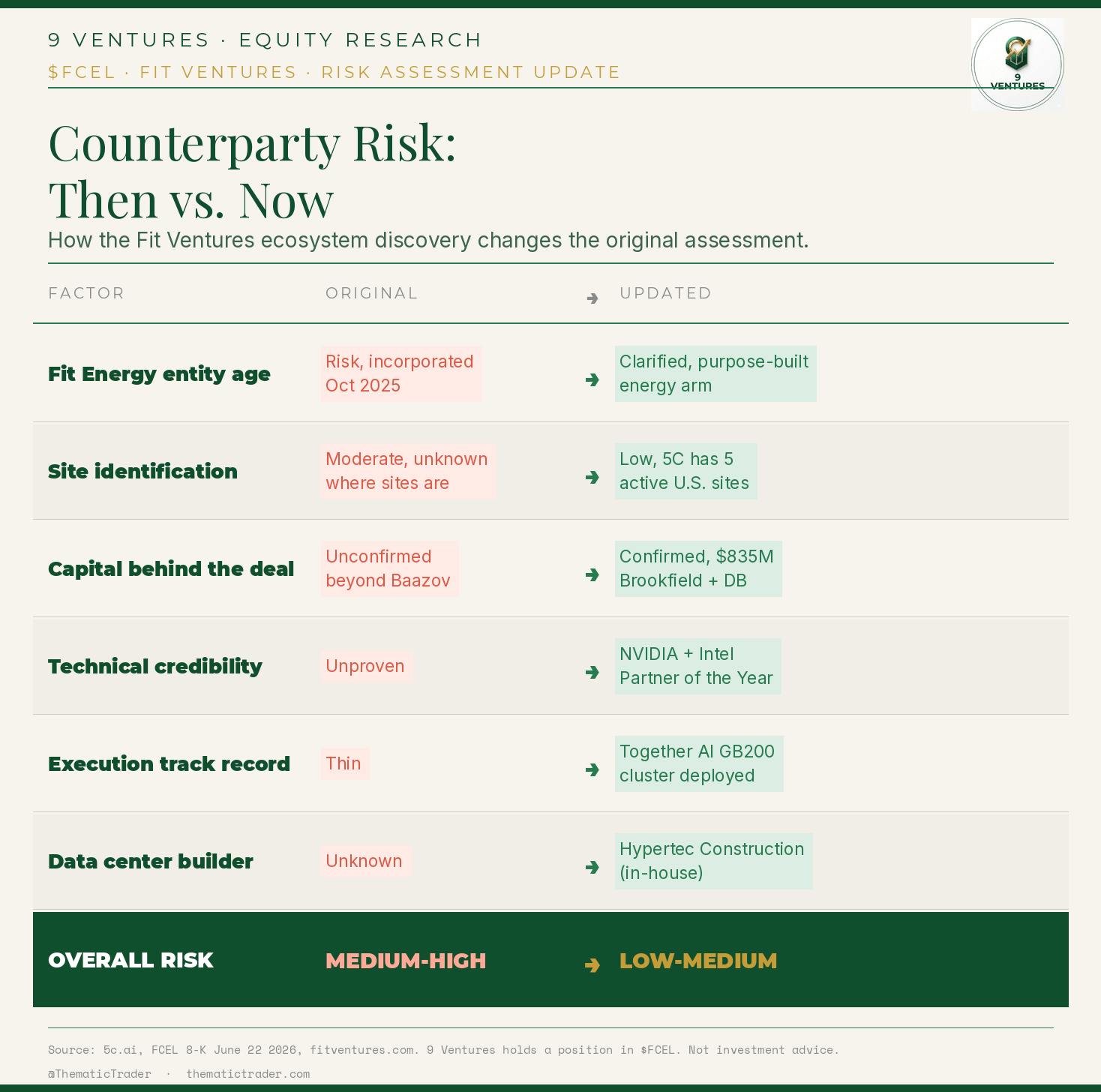
Fit still has to elect each phase and post non-refundable deposits. The warrants expire June 22, 2028 if nothing moves. The structural protections for FCEL remain in place.
This is not financial advice. 9 Ventures holds a position in $FCEL. Always do your own due diligence.