

The Magnet Tax: Why the Humanoid Race Begins at the Refinery

The growth of the robotics industry provides a massive tailwind for the entire American Resources Corporation ($AREC) ecosystem. Humanoid robots like the Tesla Optimus require high-performance Neodymium (Nd) magnets to achieve human-level dexterity. Each robot requires several kilograms of these rare earth materials. As production scales to millions of units annually, the demand for refined Neodymium will experience a structural shift.
The administration's aggressive onshoring policies and the imposition of strategic tariffs on Chinese critical minerals serve as a protective barrier. These measures insulate the domestic supply chain from Chinese predatory pricing and undercutting, ensuring that ReElement’s refining capacity remains a high-margin, non-negotiable pillar of American industrial and defense independence. American Resources Corporation has transitioned from a legacy metallurgical coal producer into a critical infrastructure provider designed to solve the refining bottleneck for these materials. Despite this transformation, the equity markets continue to value the firm at a significant discount to its peer group.
Understanding the Relationship Between AREC and ReElement Technologies
Investors must first understand the corporate structure to grasp the investment case. Following a strategic spin-off at the end of 2024, American Resources Corporation now maintains an approximately 19% minority equity stake in ReElement Technologies. This separation allows ReElement to function as a pure-play technology refiner. Meanwhile, AREC serves as the upstream engine that feeds the refinery. AREC owns 100% of Electrified Materials Corporation (EMCO). EMCO is the standalone business that collects, shreds, and processes end-of-life batteries and magnets into concentrates.
This relationship creates a "Double-Dip" revenue model for AREC:
1. Direct Sales: EMCO generates immediate revenue by selling mineral concentrates to ReElement.
2. Equity Upside: AREC captures the high-tech multiple of the refining process through its 19% ownership stake in ReElement’s profits.
Chromatography vs. Solvent Extraction
The global rare earth market is currently dominated by China. Their dominance is built on solvent extraction. This method requires massive chemical plants and thousands of gallons of toxic acids. It is an environmentally damaging and capital-intensive process that is difficult to permit in the United States. ReElement Technologies has rendered this legacy method obsolete through Ligand Assisted Displacement (LAD) Chromatography. Instead of using toxic chemicals to wash the minerals, chromatography uses pressurized columns and water-based chemistry to sort them. CEO Mark Jensen describes this advantage clearly: "We use technology that was actually utilized in the 1960s... but we didn't have the computing power to do it back then." Their technological advantage sis fortified by a formidable intellectual property moat and favorable macroeconomic shifts under the current Trump administration. ReElement Technologies holds the exclusive global license for LAD chromatography for rare earth separation, a patent portfolio that remains active through 2036. Today, the company uses simulation software to optimize these columns, allowing them to reach 99.999% (5N) purity levels. This level of purity is non-negotiable for the high-end sensors and actuators required for humanoid robots. By being cleaner and more modular, ReElement can deploy its refining pods in a fraction of the time and at a fraction of the cost of a traditional refinery.
Why AREC Beats MP Materials
While traditional miners focus on the expensive and geographically constrained process of extracting ore, ReElement focuses on the high-margin refining of that material into manufacturing-grade oxides. This allows the company to act as a midstream service provider. They capture value across multiple mineral classes without the geological risks inherent in primary mining. While MP Materials ($MP) is a formidable company, there are fundamental differences that make AREC a more compelling growth story for the 2026-2030 cycle. MP Materials owns a specific mine in California. They are tied to a specific ore body in the ground. AREC is a recycler and refiner. They are feedstock agnostic and can refine material from old hard drives, Tesla batteries, or waste from other mines. Building a traditional mine-to-magnet facility requires billions of dollars. ReElement's modular chromatography lines can be scaled in 40,000-square-foot increments. The $200 million strategic equity facility ReElement secured from Transition Equity Partners in early 2026 is enough to fully capitalize their Stage 1 goal. MP primarily focuses on light rare earths. ReElement has demonstrated the ability to produce ultra-pure Samarium, Terbium, Dysprosium, Germanium, and Gallium. These heavy rare earths are the essential ingredients for high-temperature magnets and advanced defense optics.
The Progressive Ramp Model (2026–2029)
The following model assumes ReElement utilizes their stated Tolling Model ($30k/ton fee) and EMCO captures the standard $0.35 of feedstock revenue for every dollar of refined value produced. We apply a 50% EBITDA margin (management guidance) and a 15x multiple to AREC's attributable share.
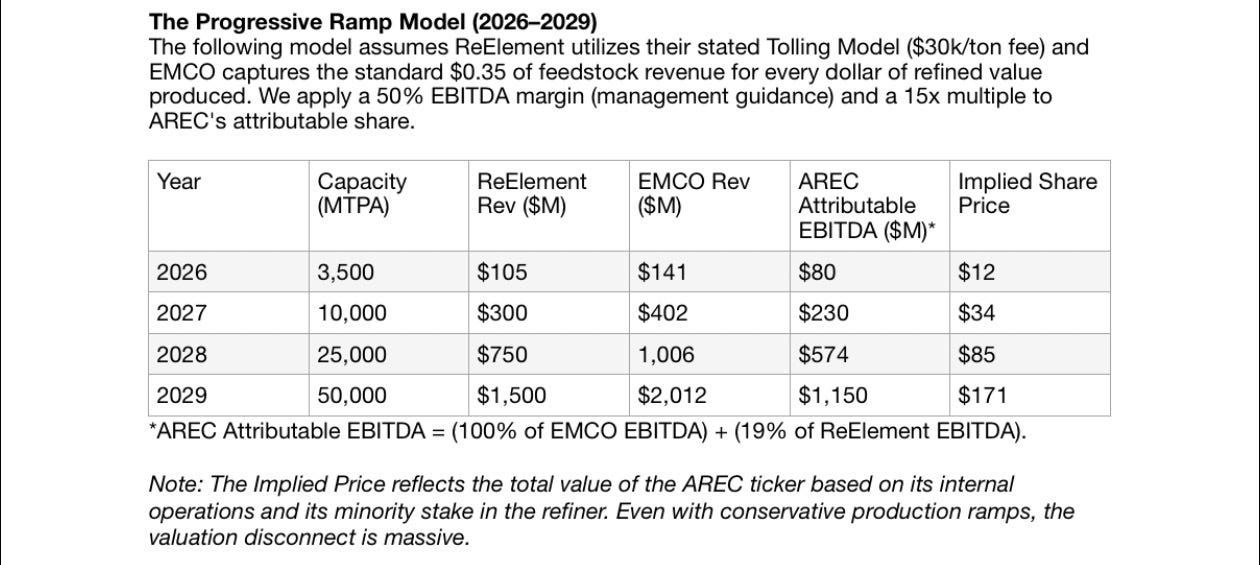
*AREC Attributable EBITDA = (100% of EMCO EBITDA) + (19% of ReElement EBITDA).
Note: The Implied Price reflects the total value of the AREC ticker based on its internal operations and its minority stake in the refiner. Even with conservative production ramps, the valuation disconnect is massive.
Insider Alignment and Institutional Support
Investors should take note of the internal conviction. Insiders own approximately 22% of AREC shares. This is an exceptionally high level of skin in the game for a company of this size. Furthermore, institutional heavyweights like Citadel Advisors have established a nearly 10% position. Management is building a circular economy engine. By January 2026, EMCO has already begun shipping lithium-ion battery scrap to the Noblesville facility.
American Resources Corporation is no longer a coal company. It is a strategic investor and the primary supplier for the only modular, clean, and scalable rare earth refinery in the Western world. By solving the refining bottleneck that China currently controls, AREC has positioned itself as a critical player in the humanoid robotics age. The market’s failure to distinguish between the legacy carbon business and the high-tech refining future is a gift to the disciplined investor. As the Marion Super Site ramps up to its 10,000-ton goal in 2026, the current $4.37 price tag will likely become a memory.